RowCoach Learn
The Coach’s NotebookNo. 01 — The connected strokeRead / Notice / Practice

A small lesson with a long reach

Find the
flow in
your stroke.

Good rowing is a sequence you can feel. Let’s look closely, piece it together, and take it to the erg.

Start with your feet. The handle follows.

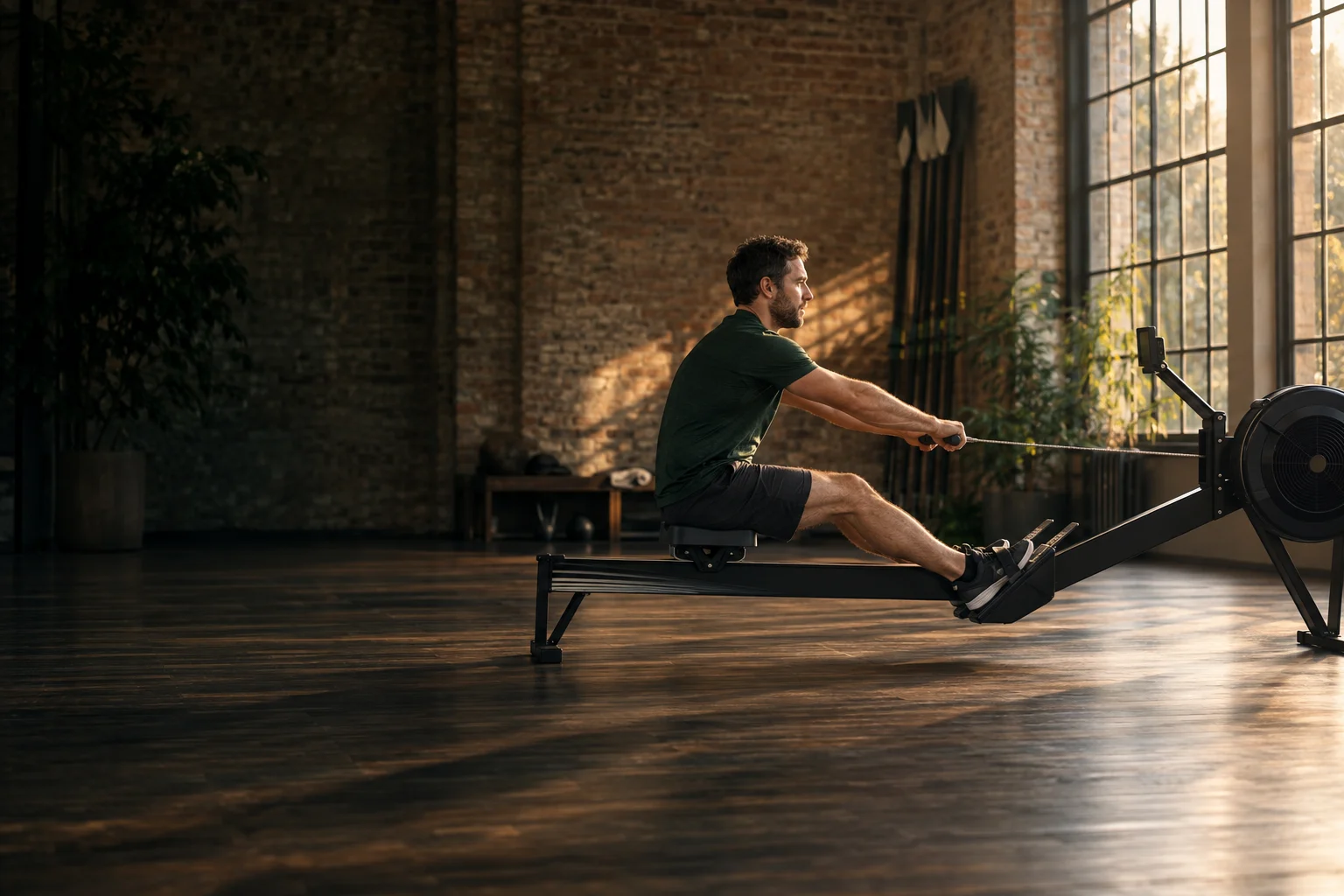
Illustrative indoor rowing studio in warm evening light.
Note 01

Power starts with the push, not the pull.

A little understanding changes the whole row.

Inside this lesson · Start at the catch

The anatomy of a stroke.

Choose a position. Watch the body move around a machine that stays still, then carry one cue into the next position.

01 / 04 Side view · handle travels level
Indoor rowing stroke positions Catch position: the rower sits forward with long arms, a forward body hinge, and shins near vertical.

Catch

Arrive ready.

Sit tall with relaxed shoulders and long arms. Hinge forward from the hips, then slide until the shins are near vertical—or as close as feels comfortable.

Watch for Reaching farther by rounding the back.

DriveLegs→Body→Arms

RecoveryArms→Body→Legs

A closer look / Recorded demo

One stroke. Four positions. One sequence.

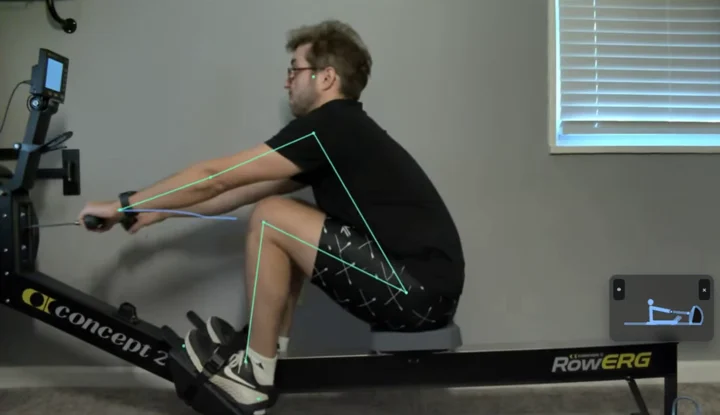
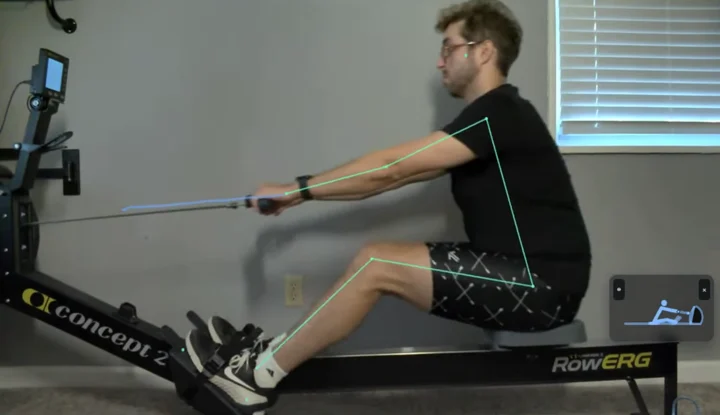
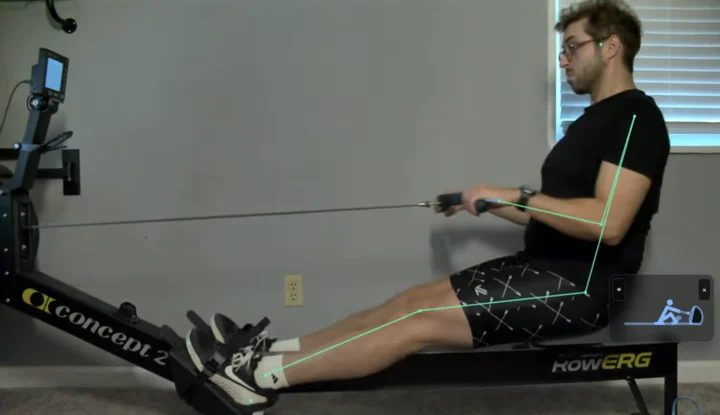
Look at three successive moments from a real RowCoach recording. These are movement examples, not an assessment of correct technique.

Recorded demo at the catch with knees bent and arms extended.
01 Catch
Recorded demo during the drive as the legs extend.
02 Drive
Recorded demo near the finish with legs extended.
03 Finish
Watch the full recorded demo

02 · Try the sequence

Your first two minutes.

Keep the pressure easy. The goal is not speed; it is to make the same order feel repeatable.

Sequence practice

2:00

Timer ready. Begin when your machine is set.

  1. 0:00–0:30

    Set

    Place the strap over the ball of each foot, set the damper around 3–5 while learning, hold the handle lightly, and sit tall.

  2. 0:30–1:00

    Build

    Take ten easy strokes while saying “legs, body, arms” and “arms, body, legs.”

  3. 1:00–1:30

    Make room

    Briefly pause after the hands move away and the body hinges forward, before the knees rise.

  4. 1:30–2:00

    Flow

    Row continuously around 18–22 spm. Think one count for the drive and two counts for the recovery.

What RowCoach can do

Carry the sequence into your next stroke.

RowCoach can help teach and reinforce conventional, efficient indoor-rowing technique with immediate visual and optional voice feedback. It is not intended to replace the judgment, context, or experience of qualified instruction.

Practice with RowCoach

04 · Add the language

Now name what you felt.

Rowing vocabulary is useful after the movement makes sense.

The stroke
Erg or RowErg
An indoor rowing machine. Rowers often call it an erg.
Stroke
One complete catch, drive, finish, and recovery cycle.
Catch
The prepared position where the drive begins.
Drive
The work phase: legs, then body, then arms.
Finish
The supported end of the drive before the hands move away.
Recovery
The controlled return: arms, then body, then legs.
Layback
The small backward body angle at the finish.
Ratio
The timing relationship between a faster drive and a more patient recovery.
The monitor
Stroke rate
Strokes per minute, shown as spm or s/m. A lower rate gives beginners more time to organize the sequence.
Split
Your pace expressed as time per 500 meters. A lower split is faster.
Drag factor
A monitor reading that describes the flywheel response and makes machine feel more repeatable than damper number alone.
Force curve
A monitor graph showing how force develops during the drive.
The machine
Damper
The lever on the fan cage. Higher is not automatically better; it changes how heavy the stroke feels.
Foot stretcher
The adjustable foot plate and strap. The strap should cross the ball of the foot.

Keep learning

Take one cue into the next stroke.

This lesson is educational and cannot account for your health, equipment, mobility, or complete rowing context.

Practice with RowCoach